
About us
Learn why UAL Online is a fantastic choice to study an MA online. Our online postgraduate courses are taught 100% remotely, with outstanding support for students.
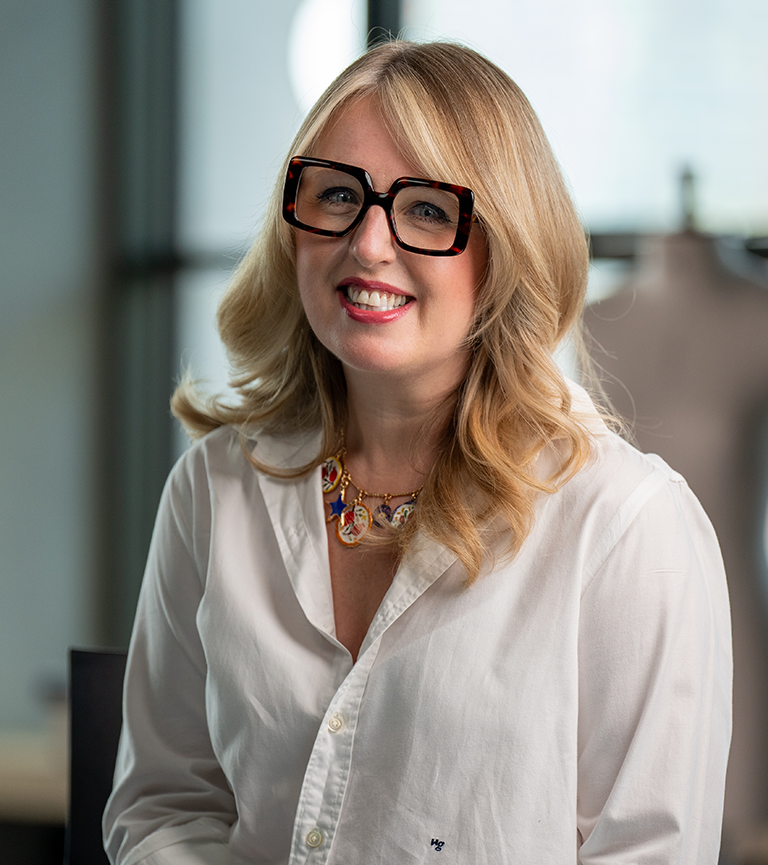
Kirsty Nevett is the Course Leader for MA Fashion Marketing (Online) and MA Fashion Business (Online), bringing over 20 years of fashion industry experience and award-winning excellence in teaching and learning. During her time in industry, Kirsty has worked across a wide range of categories from womenswear, childrenswear and beauty to menswear and sports.
Starting in womenswear retail at just 16, she climbed up the retail management ladder before moving into buying and merchandising roles, where she became a childrenswear buyer for Harrods of London. As her career progressed, she moved into strategic leadership roles, serving as Head of Global Business Development at Gloverall and Head of Innovation at Lyle & Scott.
Skip to 2025, Kirsty is teaching the next generation of fashion marketing and business leaders. Recognised by her students for fostering a strong sense of community in the online classroom, she received the Arts SU Award for Outstanding Teaching in 2024.
We spoke with Kirsty about UAL Online’s 2 fashion courses, the future of the fashion industry and what she’s looking for in an online student.
I've loved fashion for as long as I can remember. Since I was a little girl, I was always doodling and styling my Barbie dolls, whilst poring through my mum's magazines and coffee table books. My earliest memory of an icon (beyond my Barbie dolls) was Princess Diana. She'll always be an icon to many, even posthumously. Her '80s cycling shorts and oversized varsity sweats are big this season. Fashion just feels in my blood and being.
Education brings together my love of being with people, lifelong learning and my deep passion for the fashion industry. I came into higher education almost by accident through an invitation from my own Master’s supervisor. She invited me to deliver a guest lecture at London College of Fashion for the Strategic Fashion Marketing course. That led to a few more, followed by some work as a panellist at an industry talk, and before I knew it, I was hooked… I felt like I’d found my purpose. The fashion industry was (and still is) in a state of disruption, so moving into education and inspiring new talent to go and ‘fix’ the industry I loved felt like a natural next step.
I started out studying marketing with German and Spanish at the University of Strathclyde in Glasgow, but after doing well in my first year, I decided to take one of the remaining spaces on the law degree, which I soon discovered wasn’t very me – I missed the creativity of Marketing. After some time out working as a trainee management consultant, I returned to complete my studies, pivoting to a classic business degree at Glasgow Caledonian University, focusing on marketing, consumer behaviour and economics. I then progressed to do my Master’s of Science in Fashion Marketing, which I loved.
My thesis looked at how to create a model for forecasting trends and strategically managing the design process. I remember my Master’s fondly and I can empathise with my students, having been in the same shoes myself as they are now. I acknowledge how challenging postgraduate study can be, but I also know its value. It is incredibly rewarding and without a doubt, a great propeller to moving into a successful career in fashion.
This is a little embarrassing but despite having worked in fashion my whole adult life and being a very creative person, I can't even sew a button on... I am useless! I do have a second-hand sewing machine my mother gave me and I do intend on finding time one day to learn how to do the basics. The truth is, I think I'm more about the creative ideas and the strategy of fashion than being a great artist or maker. I have a tremendous admiration for anybody who is an accomplished dressmaker, tailor or pattern cutter.
I’ve learned there is a real push-pull between creativity and commerciality. By that I mean the challenge of being able to create amazing collections that inspire future generations, while always ensuring those collections are still viably commercial. It’s this dichotomy that we’ve woven throughout the courses, allowing students to explore how we blend creativity, artistry and innovation with commerciality and longevity, whilst ensuring we act with the integrity of our planet and its people in mind.
I’m inspired by a plethora of people. From a business perspective, I had the privilege of working for a CEO at Lyle & Scott called Philip Oldham, who was the most incredible leader I have ever worked for. I often draw on a lot of his insights and strategies when I'm teaching. I’m also a huge admirer of female founders such as Natalie Massanet, Alexis Inge, Anya Hindmarsh and Vivienne Westwood.
From the design side, I think Jonathan Anderson (who’s a graduate from London College of Fashion!) is a tremendous talent. His vision seems to know no bounds, which is really exciting. I can't wait to see where he goes with Dior. For me, he’s one of the most exciting designers since Lee McQueen and John Galliano (both of whom I’ve admired since the early 90s). I’m also very inspired by what’s happening at Chloe under Chemena Kamali and with Phoebe Philo for her namesake brand. There’s still lots of incredible talent to admire.
London College of Fashion is one of the top universities in the world, and when it comes to fashion, I am incredibly proud to be connected to this brand. We are unique in the sense that we offer business degrees with a fashion lens. That is something that no other university anywhere in the world can do quite like we do. The Fashion Business School is invigorating, it’s energetic, and we're constantly innovating our practice as teachers.
It was only a few years ago that the now founders of Rixo graduated with their degrees from the Fashion Business School. We’ve produced many incredible talents. When I was writing these courses, it was a really big part of our leverage that we had the ability to create strategic thinkers who could apply their creativity. And I think that's what’s so special about the online offer in particular.
Our students! The best moment as a teacher is having contact with your students, whether that's through email or seeing them in live sessions and tutorials. Watching them blossom from talented pockets of potential to fully realised academics and business leaders is a humbling privilege. I'm proud that we can give a wider range of people the opportunity to come and study at London College of Fashion. The online cohort is incredibly dynamic and rich as a result.
Fashion Means Business is a real favourite because every single student that comes through these courses will study it, and it allows us to reflect on our learnings from some of the industry’s most pivotal moments. We explore the history of fashion, the contemporary landscape, and discuss where fashion is heading in the future, as well as considering how the four pillars of fashion business (people, profit, planet and purpose) must give and take to create a commercially viable, creative, inclusive and safe future for us all. I believe that this unit acts as a great foundation to give our students the confidence to further stretch themselves throughout the rest of their course.
One thing that postgraduate study does so beautifully is that it encourages our students to think critically and subjectively. It's about how you apply your research, your knowledge, your intellect, and your instinct to come up with fantastic solutions. We will help you put the rigour behind your ideas, and that's where we see talent really blossom.
Gosh, so many. Firstly, we must mention AI. It’s making waves in design, predicting trends, and personalising consumer experiences amongst many other things. It’s a big area to watch. Secondly, there’s the absolute necessity of better sustainable practices. There’s a real need for greener and more inclusive ways of working, but it’s still a big hurdle. The challenge is figuring out how to produce ethically without losing creativity or raising prices too high. Finally, I’m interested in the partnership of technology and creativity. Tech is letting us be more creative than ever. It’s not just about efficiency; it’s about new ways to make and experience fashion.
Firstly, curiosity. I think it’s really important to remind our students that their education does not finish when they complete the course… the most exciting leaders of today are committed to lifelong learning. Things are changing so much and so quickly that it’s becoming ever more essential. Curiosity also plays out in the ability to continue to question, challenge and refresh practices that become normalised. You have to question things, to apply reason, knowledge, intellect and instinct to situations, and look forward rather than backwards.
Secondly, creativity and thirdly, strategic thinking. We often have those who have come from traditional arts and design backgrounds tell us that they’re not very strategic, but we’ll give you the tools and confidence so you can lead, maybe start your own business, or be an entrepreneur who can disrupt these incumbent businesses. On the other side, we find those who have come from business backgrounds feel like they’re not creative enough, but they have a real love of fashion. Creativity is very subjective! They might not be artistic, but we train our students how to apply creativity in how they think, how they explore new ideas and how they look forward.
Fashion is ever evolving, but I think we’re moving towards real circular design and genuine transparency, with consumers demanding to know exactly how and where things are made. I think we’ll continue to see lab-grown and smart fabrics, on-demand production and the rise of digital wardrobes. Tech and sustainability will work hand in hand, and it’s an exciting chance to reimagine fashion as a force for positive change, and I believe our students are the ones who will make that happen.
I'm always looking for students to be super curious. I believe it's one of the most important skills anyone can have. I also need to see a considered commitment because a postgraduate degree is hard work, taking around 21 hours a week. We will flex and support our students to fit their studies into their busy lives, but they need to have a level of commitment to make it work.
I’m always keen to see someone who can manage opinions. You'll have lots of different ideas, thoughts and viewpoints thrown at you, and what you have to do is to be critical in applying sense to these opinions and be able to extrapolate the appropriate insights that inform your work.
To just apply and give it a go. Make sure you're ready, and then just press that button and get in touch. Speak to the Recruitment Team and find out more about the course. Don't be constrained by thinking you haven’t got this, you haven’t got that, because we are trained to see great talent.
This could be the thing that changes your life forever.
Learn why UAL Online is a fantastic choice to study an MA online. Our online postgraduate courses are taught 100% remotely, with outstanding support for students.

Explore top fashion business careers and discover emerging trends and opportunities in the industry. Learn how strong business and fashion knowledge, combined with essential marketing skills and business skills, can lead to success in this fast-paced field.

Compare UAL Online's Fashion Marketing and Fashion Business Master's degrees. Discover key differences and which path suits your career goals.

Learn why UAL Online is a fantastic choice to study an MA online. Our online postgraduate courses are taught 100% remotely, with outstanding support for students.